Watteaus Pilgrimage to Cythera Is Rococo in Its Art History
Embarkation for Cythera
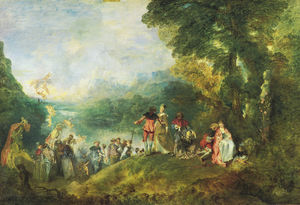
- Appointment of Cosmos:
- 1717
- Alternative Names:
- Pilgrimage to Cythera, Voyage to Cythera, Pilgrimage on the Island of Cythera
- Height (cm):
- 129.00
- Length (cm):
- 194.00
- Medium:
- Oil
- Support:
- Sheet
- Subject:
- Scenery
- Art Movement:
-
Rococo
- Created past:
- Current Location:
-
Paris, France
- Displayed at:
-
Musée du Louvre
- Possessor:
-
Musée du Louvre
- Embarkation for Cythera Page'south Content
- Story / Theme
- Inspirations for the Work
- Analysis
- Related Paintings
- Locations Through Time - Notable Sales
- Artist
- Art Period
- Bibliography
-

Embarkation for Cythera
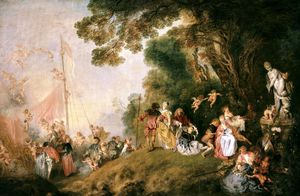
The Embarkation for Cythera is an emblematic love story at its finest. What better identify could Watteau take selected for immature lovers to go than to Cythera, the beautiful Greek island of love?
Historians nevertheless debate whether the pilgrims are on their way to the island or in fact preparing to leave. The majority lean towards their leaving. No matter the location, a group of young couples enjoy some other on the densely vegetated isle.
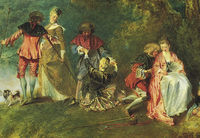
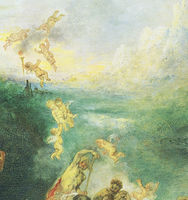
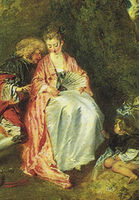
The focus falls on iii couples in particular who occupy the center right. The sitting couple is captivated in a flirtatious conversation and the pair standing is preparing to take their place on the boat. The last gentleman helps the object of his affection. Other happy couples are boarding the gunkhole. Take note of the cupids hovering almost the vessel, they are excited well-nigh the lover's journey.
-
Embarkation for Cythera
-
Houdar de la Motte

Watteau'south inspiration for The Embarkation for Cythera culminated from a few different sources. He was inspired past fantastical geographical locations as well as from his beloved theater.
Cythera:
Known as Kithira, in mod Greek, Cythera is a southernmost and easternmost island of the Ionian Islands. It has a mountainous interior, rising to 1,663 anxiety.
In Antiquity, Cythera was believed to exist the birthplace of Aphrodite - Greek goddess of love - and thus became known as the Isle of Love. Watteau's portrayal of Cythera is perhaps the best deception the virtually brilliant imagination could conjure up.
His is an island of love, a paradise decorated with brightly colored landscapes that would enchant fifty-fifty the almost plutonic friends to accept the invitation of love. Cupids can be seen flying over the boat, though their services may not be needed as nature does the flirting and mesmerizing quite effectively.
Les Trois Cousines:
This was a prose play by French comedy and tragedy playwright Florent Dancourt and it may have been an inspiration for The Embarkation for Cythera as a group of youths disguised as pilgrims of love set up for a voyage to Cythera in the finale.
Yet this may exist the only similarity to Watteau's painting - Dancourt's sarcastic parody would exist a spotty reflection of Watteau'south happy and hazy dream.
La Ventienne:
Houdar de la Motte's opera ballet seems a more likely inspiration for The Embarkation for Cythera equally it featured stock characters of the Commedia dell'Arte and other pilgrims who accustomed the invitation to the island of love. Watteau pursued both of these themes.
-
Embarkation for Cythera
-
Embarkation for Cythera
-
Embarkation for Cythera


In his famous reception piece for the Academie, Watteau shocked the judges with his original mode. His revival of colors reminiscent to earlier centuries and the lighting of his piece were particularly striking.
Composition:
All elements of The Embarkation for Cythera are in a head-on perspective. Watteau employs certain techniques to ensure that the viewer looks at his entire composition. The progression of the pilgrims returning to the boat draws attention to the three master couples in the centre, who in a lover's trance, lost track of fourth dimension.
Viewers then glance upwards as the space of the canvas is filled with a hazy sky that only Watteau could produce. From in that location, the viewer is enamored by a beautiful landscape as the clouds bring the focus downward.
Tone:
The theme of this piece cannot assist simply bring about a happy, peaceful mood. There is no sign of ache, broken hearts or turmoil in any capacity. Instead, lovers prance around together and cupids wing overhead.
Clearly, Watteau intended The Embarkation for Cythera to requite the notion of a fine fantasy.
Brushstrokes:
Watteau was known for using a light and airy brushstroke to create his hazy dream-like atmospheres. This is particularly evident in the wispy clouds and lazy leaves.
Color Palette:
The landscape's brilliant palette echoes that of 16th century Venetian paintings. The neutral palette of the mural is complemented nicely by the pastels of the lover'southward costumes.
Lighting:
The lighting cast in this dream plays upward the brilliant colors of the character's article of clothing. The center of the canvas lights up the three main couples and the shadows retreat to play in the trees then less attending is paid to other characters.
-
Pilgrimage to Cythera
-
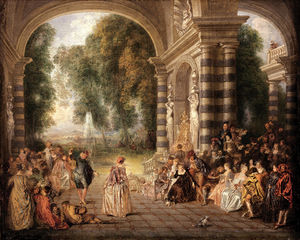
The Pleasures of the Brawl
-
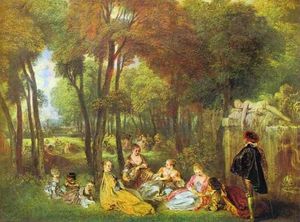
Les Champs Elysées
-
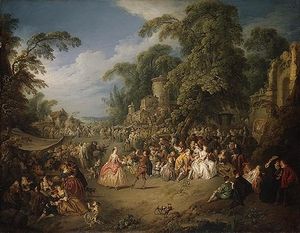
Jean-Baptiste-Joseph Pater
Works by Watteau:
Watteau took a potent liking to theatrical scenes of everyday life portrayed through Italian comedies and ballet. The jovialities of human life flitter across his unique landscapes and atmospheres. He painted over a dozen pieces under the fétes galantes theme. Other examples include;
Pilgrimage to Cythera, 1718-1721:
The second version of this composition which today hangs in the Charlottenburg Palace, Berlin.
The Pleasures of the Ball 1717:
Once once again, Watteau does an extraordinary job of convincing viewers that his conjured up reality is no longer a dream but the manner life should be. The way his characters at the Ball enjoy themselves, as if noting could disturb their bliss, makes the viewer desire to leap into the painting and bring together in the festivities.
The effulgence of the lord's day and the brilliant colors further entice the viewer. Watteau's hallucinatory landscape also taunts the viewers; as he will finally realize his participation, at best, will just happen in a fantasize.
Perchance Watteau felt the same fashion, longing to be a part of his fantastical, theatrical creation. This is, after all, the entire purpose of make-believe and pretend.
Les Champs-Elysées 1717:
In Watteau's Les Champs-Elysées, his characters enjoy another hazy afternoon, relaxing on the comfort the lush grass provides them. The women are being pursued past two caped suitors while three children play close by. In true Watteau fashion, the colorful foliage provides a superb backdrop for his honey characters.
Works by other artists:
Watteau's fantasy theme continued on the canvasses of other Rococo artists such as Jean-Baptiste-Joseph Pater. Clearly the theme of this Pater painting was inspired past Watteau.
Jean-Baptiste-Joseph Pater, The Fair at Bezons, c. 1733:
Depicted in the oil painting is a group of commedia dell'arte players at the left in the distance. Said characters are enjoying their fourth dimension at an annual Sunday off-white merely outside of Versailles, an thought not too afar of Watteau's very own interpretations of how humans should enjoy life.
-
Musée du Louvre
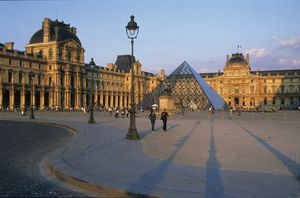
Embarkation for Cythera remained in the possession of the Royal Academy of Painting and Sculpture until it was moved to the Musee du Louvre (previously known was the Museum Fundamental des Arts de la Republique) in 1793, 76 years after its completion.
-
L'Enseigne de Gersaint
-
Mezzetin
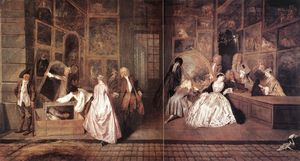
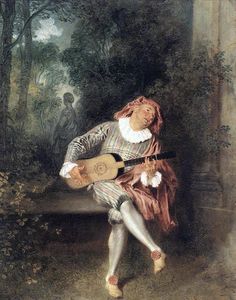
Jean-Antoine Watteau's Embarkation for Cythera acquired a major reaction after its completion in 1717. Centuries later art critics are still focusing on Watteau'south work.
Proof that Watteau still draws the interest of modern twenty-four hours art critics can be seen in the many recently published books whose contents are in complete dedication to his piece of work.
Such positive reflections tin be read in Jed Perl's 2008 publication, Antoine'due south Alphabet: Watteau and His Globe. The adoration doesn't stop there. Acclaimed British art historian, Sir Michael Levey, said "Watteau created, unwittingly, the concept of the individualist artist loyal to himself, and himself lonely."
Watteau's Embarkation for Cythera received probably the best reaction any artist could dream of, especially a young, undiscovered ane.
The judges of the Academy judging his reception slice were shocked by what they saw - Watteau'southward chromatic theatrical universe. They were pleasantly delighted, conjuring upwardly the inspired title "fétes galantes" (lively, gallant party) and accepting Watteau nether this new genre. They felt he truly was in a category of his own.
Jean-Antoine Watteau is attributed to extending the premises of 18th century French-born artistic menstruation Rococo, across architecture, furniture and sculpture and into painting. He adult a unique mode and revolutionized the art earth through his individuality. This was seen not merely in the themes of his piece of work (very theatrically influenced) simply also in his mode (ornate, blusterous).
-
Nicolas Pineau
-
Seated Adult female
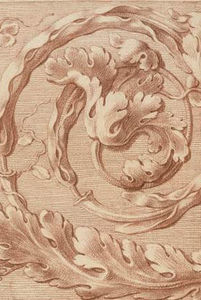
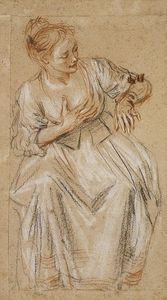
Watteau was a key player in the 18th century Rococo art move. The give-and-take Rococo is a combination of the French rocaille, or crush, due to the heavy usage of beat out-like curves, and the Italian barocco, or Baroque style for its decorative nature.
Its style emergence was get-go displayed in the decorative arts and interior design before Watteau adapted it toward painting aesthetics. Louis XV'due south succession brought a change in the court artists and general artistic mode.
By the cease of the old rex's reign, rich Bizarre designs were giving way to lighter elements with more curves and natural patterns. These elements are obvious in the architectural designs of Nicolas Pineau.
During the Régence, court life moved away from Versailles and this creative change became well established, first in the majestic palace and then throughout French high society. The effeminateness and playfulness of Rococo designs is often seen as perfectly in melody with the excesses of Louis 15's regime.
Rococo painting, besides as almost French art of the 18th century was calorie-free, blusterous, frilly and bejeweled, which is fitting as information technology was intended for the powerful aristocracy and wealthy upper-middle grade.
Watteau'due south creative content could exist summarized by two major influences: his dearest for the theater and his fascination of the Rococo styling and design.
Spending his early years in Paris in the workshop of set designer Claude Gillot, Watteau gained his love for the theater, specifically for the Italian Commedia dell'Arte and its innumerable characters. Shortly after, he worked for interior designer Claude Audran III and picked upward Rococo pattern influences.
Watteau's allure to Rococo'due south curving lines and decorative nature became central to his later piece of work. As his career progressed the creative person combined his love for the theater and his fascination of the Rococo styling and blueprint and adult a truly unique manner of painting with ornate elegance that gained him critical attention.
To observe out more than about Watteau and his works please cull from the post-obit recommended sources.
• Lauterbach, Iris. Antoine Watteau: 1684-1721. PLACE, 2008
• Mollett, John William. Watteau. Kessinger Publishing, LLC, 2007
• Perl, Jed. Antoine'due south Alphabet: Watteau and His World. Random Business firm, 2008
• Posner, Donald. Antoine Watteau. Cornell University Printing, 1984
• Rogers, Robert Emmons. Behind A Watteau Picture show: A Fantasy in Verse in One Act. Kessinger Publishing, LLC, 2007
• Sheriff, Mary D. Antoine Watteau: Perspectives on the Creative person and the Culture of His Fourth dimension. University of Delaware Press, 2006
• Stranahan, C. H. A History of French Painting From the Earliest To Its Latest Practice. Charles Scribner's Sons, 1918
• Zeri, Federico. Watteau: The Embarkation for Cythera. NDE Publishing, 2000
Source: https://www.artble.com/artists/antoine_watteau/paintings/embarkation_for_cythera

Post a Comment for "Watteaus Pilgrimage to Cythera Is Rococo in Its Art History"