True or False? ââ“ Greek Art Literature and Philosophy Came to Us Through the Roman Tradition

Aboriginal Greek literature is literature written in the Ancient Greek linguistic communication from the earliest texts until the time of the Byzantine Empire. The primeval surviving works of ancient Greek literature, dating back to the early Archaic flow, are the two epic poems the Iliad and the Odyssey, prepare in an idealized primitive past today identified equally having some relation to the Mycenaean era. These two epics, along with the Homeric Hymns and the two poems of Hesiod, Theogony and Works and Days, constituted the major foundations of the Greek literary tradition that would continue into the Classical, Hellenistic, and Roman periods.
The lyric poets Sappho, Alcaeus, and Pindar were highly influential during the early on development of the Greek poetic tradition. Aeschylus is the earliest Greek tragic playwright for whom whatever plays have survived complete. Sophocles is famous for his tragedies about Oedipus, particularly Oedipus the King and Antigone. Euripides is known for his plays which often pushed the boundaries of the tragic genre. The comedic playwright Aristophanes wrote in the genre of Old Comedy, while the later playwright Menander was an early pioneer of New Comedy. The historians Herodotus of Halicarnassus and Thucydides, who both lived during the fifth century BC, wrote accounts of events that happened soon before and during their ain lifetimes. The philosopher Plato wrote dialogues, normally centered around his teacher Socrates, dealing with various philosophical subjects, whereas his student Aristotle wrote numerous treatises, which later on became highly influential.
Of import later writers included Apollonius of Rhodes, who wrote The Argonautica, an epic poem near the voyage of the Argonauts; Archimedes, who wrote groundbreaking mathematical treatises; and Plutarch, who wrote mainly biographies and essays. The second-century Advertising writer Lucian of Samosata was a Greek, who wrote primarily works of satire.[i] Ancient Greek literature has had a profound touch on on subsequently Greek literature and as well western literature at big. In detail, many ancient Roman authors drew inspiration from their Greek predecessors. Ever since the Renaissance, European authors in general, including Dante Alighieri, William Shakespeare, John Milton, and James Joyce, have all fatigued heavily on classical themes and motifs.
Pre-classical and classical antiquity [edit]
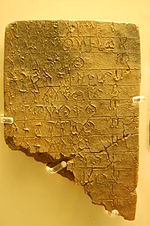
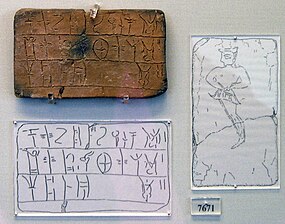
This period of Greek literature stretches from Homer until the fourth century BC and the rise of Alexander the Smashing. The primeval known Greek writings are Mycenaean, written in the Linear B syllabary on dirt tablets. These documents contain prosaic records largely concerned with merchandise (lists, inventories, receipts, etc.); no real literature has been discovered.[2] [three] Michael Ventris and John Chadwick, the original decipherers of Linear B, state that literature almost certainly existed in Mycenaean Hellenic republic,[3] simply information technology was either not written down or, if it was, it was on parchment or wooden tablets, which did not survive the destruction of the Mycenaean palaces in the twelfth century BC.[three]
Greek literature was divided in well-defined literary genres, each one having a compulsory formal structure, about both dialect and metrics.[4] The first partition was between prose and verse. Inside poesy there were three super-genres: ballsy, lyric and drama. The common European terminology most literary genres is direct derived from the aboriginal Greek terminology.[5] Lyric and drama were further divided into more genres: lyric in iv (elegiac, iambic, monodic lyric and choral lyric); drama in three (tragedy, comedy and pastoral drama).[6] Prose literature can largely be said to begin with Herodotus.[7] Over time, several genres of prose literature developed,[seven] but the distinctions between them were frequently blurred.[7]
Epic poetry [edit]
At the beginning of Greek literature stand the ii monumental works of Homer, the Iliad and the Odyssey.[8] : one–3 The figure of Homer is shrouded in mystery. Although the works every bit they now stand are credited to him, it is certain that their roots accomplish far back earlier his time (come across Homeric Question).[viii] : xv The Iliad is a narrative of a single episode spanning over the form of a x-solar day-period from near the end of the ten years of the Trojan War. Information technology centers on the person of Achilles,[9] who embodied the Greek heroic ideal.[10] [8] : 3

The Odyssey is an business relationship of the adventures of Odysseus, one of the warriors at Troy.[8] : three Later 10 years fighting the war, he spends another ten years sailing back habitation to his wife and family. Penelope was considered the platonic female; Homer depicted her as the ideal female person based on her delivery, modesty, purity, and respect during her marriage with Odysseus. During his ten-twelvemonth voyage, he loses all of his comrades and ships and makes his mode home to Ithaca disguised every bit a beggar. Both of these works were based on ancient legends.[8] : 15 The Homeric dialect was an primitive language based on Ionic dialect mixed with some chemical element of Aeolic dialect and Attic dialect,[11] the latter due to the Athenian edition of the 6th century BC. The epic verse was the hexameter.[12]
The other smashing poet of the preclassical period was Hesiod.[8] : 23–24 [xiii] Different Homer, Hesiod refers to himself in his poetry.[14] Nevertheless, nothing is known about him from any external source. He was a native of Boeotia in key Greece, and is thought to take lived and worked effectually 700 BC.[15] Hesiod'due south ii extant poems are Works and Days and Theogony. Works and Days is a faithful depiction of the poverty-stricken country life he knew so well, and it sets along principles and rules for farmers. Theogony is a systematic business relationship of creation and of the gods. It vividly describes the ages of mankind, first with a long-by Golden Age.[sixteen]
The writings of Homer and Hesiod were held in extremely high regard throughout antiquity[thirteen] and were viewed by many ancient authors equally the foundational texts behind ancient Greek religion;[17] Homer told the story of a heroic by, which Hesiod bracketed with a cosmos narrative and an business relationship of the practical realities of contemporary daily life.[8] : 23–24
Lyric poetry [edit]
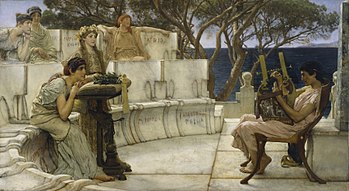
Lyric poetry received its name from the fact that it was originally sung by individuals or a chorus accompanied by the instrument called the lyre. Despite the name, the lyric poetry in this full general meaning was divided in four genres, two of which were non accompanied by cithara, merely by flute. These two latter genres were elegiac poetry and iambic poetry. Both were written in the Ionic dialect. Elegiac poems were written in elegiac couplets and iambic poems were written in iambic trimeter. The first of the lyric poets was probably Archilochus of Paros, 7th century BC, the about important iambic poet.[18] Only fragments remain of his work, every bit is the example with most of the poets. The few remnants suggest that he was an embittered adventurer who led a very turbulent life.[xix]
Many lyric poems were written in the Aeolic dialect. Lyric poems often employed highly varied poetic meters. The most famous of all lyric poets were the so-chosen "Nine Lyric Poets".[20] Of all the lyric poets, Sappho of Lesbos (c. 630 – c. 570 BC) was by far the near widely revered. In artifact, her poems were regarded with the same caste of respect equally the poems of Homer.[21] Only ane of her poems, "Ode to Aphrodite", has survived to the present day in its original, completed course.[22] In add-on to Sappho, her contemporary Alcaeus of Lesbos was besides notable for monodic lyric verse. The poesy written by Alcman was considered beautiful, even though he wrote exclusively in the Doric dialect, which was normally considered unpleasant to hear.[23] The later poet Pindar of Thebes was renowned for his choral lyric poetry.[24]
Drama [edit]
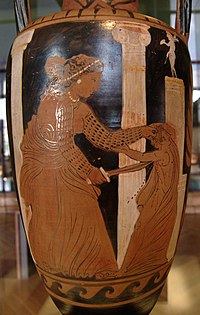
All surviving works of Greek drama were composed by playwrights from Athens and are written exclusively in the Attic dialect.[25] Choral performances were a mutual tradition in all Greek city-states.[25] The Athenians credited a man named Thespis with having invented drama[25] past introducing the first actor, whose primary purpose was to interact with the leader of the chorus.[26] Afterward playwrights expanded the number of actors to iii, assuasive for greater freedom in storytelling.[27]
In the historic period that followed the Greco-Farsi Wars, the awakened national spirit of Athens was expressed in hundreds of tragedies based on heroic and legendary themes of the by. The tragic plays grew out of unproblematic choral songs and dialogues performed at festivals of the god Dionysus. In the classical period, performances included three tragedies and one pastoral drama, depicting four different episodes of the same myth. Wealthy citizens were called to bear the expense of costuming and training the chorus as a public and religious duty. Omnipresence at the festival performances was regarded equally an act of worship. Performances were held in the bully open-air theater of Dionysus in Athens. The poets competed for the prizes offered for the best plays.[28]
All fully surviving Greek tragedies are conventionally attributed to Aeschylus, Sophocles or Euripides. The authorship of Prometheus Leap, which is traditionally attributed to Aeschylus,[29] and Rhesus, which is traditionally attributed to Euripides, are, nonetheless, questioned.[30] There are seven surviving tragedies attributed to Aeschylus. 3 of these plays, Agamemnon, The Cooler-Bearers, and The Eumenides, grade a trilogy known as the Oresteia.[31] One of these plays, Prometheus Bound, however, may actually be the work of Aeschylus's son Euphorion.[32]
7 works of Sophocles have survived, the well-nigh acclaimed of which are the iii Theban plays, which center effectually the story of Oedipus and his offspring.[33] The Theban Trilogy consists of Oedipus the King, Oedipus at Colonus, and Antigone. Although the plays are ofttimes called a "trilogy," they were really written many years autonomously. Antigone, the last of the three plays sequentially, was actually first to be written, having been composed in 441 BC, towards the kickoff of Sophocles's career.[34] Oedipus the King, the nigh famous of the three, was written effectually 429 BC at the midpoint of Sophocles'south career.[Notes 1] Oedipus at Colonus, the second of the three plays chronologically, was actually Sophocles'due south last play and was performed in 401 BC, after Sophocles's expiry.[35]
There are nineteen surviving plays attributed to Euripides. The most well-known of these plays are Medea, Hippolytus, and Bacchae.[36] Rhesus is sometimes thought to have been written by Euripides' son, or to have been a posthumous reproduction of a play by Euripides.[37] Euripides pushed the limits of the tragic genre and many of the elements in his plays were more typical of comedy than tragedy.[38] His play Alcestis, for instance, has often been categorized every bit a "problem play" or perhaps even every bit a work of tragicomedy rather than a true tragedy due to its comedic elements and the fact that information technology has a happy ending.[39] [twoscore]
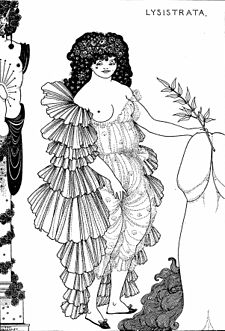
Like tragedy, comedy arose from a ritual in honor of Dionysus, but in this case the plays were full of frank obscenity, corruption, and insult. At Athens, the comedies became an official office of the festival celebration in 486 BC, and prizes were offered for the best productions. As with the tragedians, few works still remain of the great comedic writers. The only complete surviving works of classical one-act are 11 plays written by the playwright Aristophanes.[41] These are a treasure trove of comic presentation. He poked fun at everyone and every institution. In The Birds, he ridicules Athenian democracy. In The Clouds, he attacks the philosopher Socrates. In Lysistrata, he denounces war.[42] Aristophanes has been praised highly for his dramatic skill and artistry. John Lemprière's Bibliotheca Classica describes him as, quite merely, "the greatest comic dramatist in world literature: by his side Molière seems slow and Shakespeare clownish."[43] Of all Aristophanes'due south plays, however, the one that has received the most lasting recognition is The Frogs, which simultaneously satirizes and immortalizes the ii giants of Athenian tragedy: Aeschylus and Euripides. When it was performed for the first time at the Lenaia Festival in 405 BC, just one year afterward the decease of Euripides, the Athenians awarded it get-go prize.[44] Information technology was the only Greek play that was ever given an encore operation, which took place two months later on at the City Dionysia.[45] Even today, The Frogs still appeals to modern audiences. A commercially successful modern musical adaptation of it was performed on Broadway in 2004.[46]
The 3rd dramatic genre was the satyr play. Although the genre was popular, only i consummate example of a satyr play has survived: Cyclops past Euripides.[47] Big portions of a second satyr play, Ichneutae past Sophocles, have been recovered from the site of Oxyrhynchus in Egypt amongst the Oxyrhynchus Papyri.[48]
Historiography [edit]

A 2d century Ad Roman copy of a Greek bust of Herodotus from the first half of the fourth century BC
2 notable historians who lived during the Classical Era were Herodotus of Halicarnassus and Thucydides. Herodotus is commonly called "The Father of History."[49] His book The Histories is amidst the oldest works of prose literature in beingness. Thucydides's book History of the Peloponnesian State of war profoundly influenced later writers and historians, including the author of the book of Acts of the Apostles and the Byzantine Era historian Procopius of Caesarea.[50]
A third historian of ancient Hellenic republic, Xenophon of Athens, began his Hellenica where Thucydides ended his piece of work about 411 BC and carried his history to 362 BC.[51] Xenophon'southward most famous piece of work is his volume The Anabasis, a detailed, showtime-mitt account of his participation in a Greek mercenary ground forces that tried to aid the Farsi Cyrus expel his blood brother from the throne. Xenophon also wrote 3 works in praise of the philosopher Socrates: The Apology of Socrates to the Jury, The Symposium, and Memorabilia. Although both Xenophon and Plato knew Socrates, their accounts are very different. Many comparisons have been fabricated between the account of the military historian and the account of the poet-philosopher.[52]
Philosophy [edit]
Many important and influential philosophers lived during the 5th and fourth centuries BC. Amidst the primeval Greek philosophers were the three so-called "Milesian philosophers": Thales of Miletus, Anaximander, and Anaximenes.[53] Of these philosophers' writings, nevertheless, but 1 fragment from Anaximander preserved by Simplicius of Cilicia has survived.[Notes ii] [54]
Very piffling is known for certain about the life of the philosopher Pythagoras of Samos and no writings by him have survived to the present day,[55] but an impressive corpus of poetic writings written past his pupil Empedocles of Acragas has survived, making Empedocles i of the most widely attested Pre-Socratic philosophers.[56] A big number of fragments written past the philosophers Heraclitus of Ephesus[57] and Democritus of Abdera have also survived.[58]
Of all the classical philosophers, still, Socrates, Plato, and Aristotle are generally considered the most important and influential. Socrates did non write any books himself and modernistic scholars contend whether or not Plato'southward portrayal of him is authentic. Some scholars contend that many of his ideas, or at least a vague approximation of them, are expressed in Plato's early socratic dialogues.[59] Meanwhile, other scholars have argued that Plato'southward portrayal of Socrates is merely a fictional representation intended to expound Plato's own opinions who has very little to do with the historical figure of the aforementioned proper noun.[60] The fence over the extent to which Plato's portrayal of Socrates represents the bodily Socrates's ideas is known equally the Socratic trouble.[61] [62]

Plato expressed his ideas through dialogues, that is, written works purporting to describe conversations between different individuals. Some of the best-known of these include: The Apology of Socrates, a purported tape of the spoken communication Socrates gave at his trial;[63] Phaedo, a description of the last chat between Socrates and his disciples before his execution;[64] The Symposium, a dialogue over the nature of beloved;[65] and The Republic, widely regarded equally Plato'south most important work,[66] [67] a long dialogue describing the platonic authorities.[68]
Aristotle of Stagira is widely considered to be one of the most important and influential philosophical thinkers of all time.[69] The first sentence of his Metaphysics reads: "All men past nature want to know." He has, therefore, been called the "Begetter of those who know." His medieval disciple Thomas Aquinas referred to him simply as "the Philosopher". Aristotle was a student at Plato's Academy, and like his instructor, he wrote dialogues, or conversations. However, none of these be today. The body of writings that have come down to the present probably represents lectures that he delivered at his own schoolhouse in Athens, the Lyceum.[seventy] Even from these books, the enormous range of his interests is evident: He explored matters other than those that are today considered philosophical; the extant treatises cover logic, the physical and biological sciences, ethics, politics, and constitutional regime. Among Aristotle's most notable works are Politics, Nicomachean Ethics, Poetics, On the Soul, and Rhetoric.[71]
Hellenistic period [edit]

Past 338 BC all of the Greek city-states except Sparta had been united by Philip II of Macedon.[72] Philip'southward son Alexander the Great extended his begetter's conquests greatly. Athens lost its preeminent status as the leader of Greek civilization, and it was replaced temporarily by Alexandria, Egypt.[73]
The city of Alexandria in northern Egypt became, from the 3rd century BC, the outstanding center of Greek culture. It besides soon attracted a large Jewish population, making it the largest center for Jewish scholarship in the ancient world. The Septuagint, a Greek translation of the Hebrew Bible was reputed to have been initiated in Alexandria. Philo, a Hellenistic Jewish philosopher, operated out of Alexandria at the turn of the Common Era. In addition, it later became a major focal indicate for the development of Christian thought. The Musaeum, or Shrine to the Muses, which included the library and school, was founded by Ptolemy I. The institution was from the beginning intended as a great international school and library.[74] The library, somewhen containing more than a half 1000000 volumes, was mostly in Greek. It was intended to serve as a repository for every work of classical Greek literature that could be found.[75]
Poetry [edit]

The genre of bucolic poetry was first adult by the poet Theocritus.[76] The Roman Virgil later wrote his Eclogues in this genre.[77] Callimachus, a scholar at the Library of Alexandria, equanimous the Aetia ("Causes"),[78] a long poem written in 4 volumes of elegiac couplets describing the legendary origins of obscure community, festivals, and names,[78] which he probably wrote in several stages over the course of many years in the third century BC.[78] The Aetia was lost during the Middle Ages,[78] but, over the course of the twentieth century, much of it was recovered due to new discoveries of ancient papyri.[78] Scholars initially denigrated information technology as "2nd-rate", showing slap-up learning, but defective true "fine art".[78] Over the course of the century, scholarly appraisal of it greatly improved, with many scholars at present seeing it in a much more positive light.[78] Callimachus also wrote short poems for special occasions and at least one brusk epic, the Ibis, which was directed against his former pupil Apollonius.[79] He also compiled a prose treatise entitled the Pinakes, in which he catalogued all the major works held in the Library of Alexandria.[lxxx]
The Alexandrian poet Apollonius of Rhodes is all-time known for his ballsy poem the Argonautica, which narrates the adventures of Jason and his shipmates the Argonauts on their quest to retrieve the Aureate Fleece from the state of Colchis.[81] The poet Aratus wrote the hexameter poem Phaenomena, a poetic rendition of Eudoxus of Cnidus'south treatise on the stars written in the fourth century BC.[82]
Drama [edit]
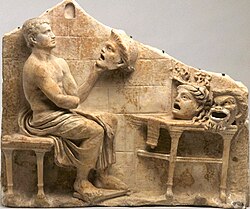
During the Hellenistic menses, the Old One-act of the Classical Era was replaced by New Comedy. The most notable author of New Comedy was the Athenian playwright Menander. None of Menander's plays have survived to the present day in their consummate class, but one play, The Bad-Tempered Man, has survived to the present day in a near-complete form. Most of another play entitled The Girl from Samos and large portions of some other v have too survived.[83]
Historiography [edit]
The historian Timaeus was born in Sicily but spent nearly of his life in Athens.[84] His History, though lost, is significant because of its influence on Polybius. In 38 books it covered the history of Sicily and Italia to the twelvemonth 264 BC, which is where Polybius begins his piece of work. Timaeus also wrote the Olympionikai, a valuable chronological study of the Olympic Games.[85]
Ancient biography [edit]
Ancient biography, or bios, as distinct from modern biography, was a genre of Greek (and Roman) literature interested in describing the goals, achievements, failures, and character of aboriginal historical persons and whether or not they should be imitated. Authors of ancient bios, such as the works of Nepos and Plutarch'southward Parallel Lives imitated many of the aforementioned sources and techniques of the gimmicky historiographies of ancient Hellenic republic, notably including the works of Herodotus and Thucydides. There were diverse forms of ancient biographies, including 1) philosophical biographies that brought out the moral grapheme of their subject (such as Diogenes Laertius'south Lives of Eminent Philosophers 2) literary biographies which discussed the lives of orators and poets (such as Philostratus's Lives of the Sophists) iii) school and reference biographies that offered a short sketch of someone including their beginnings, major events and accomplishments, and death, 4) autobiographies, commentaries and memoirs where the subject presents his own life and v) historical/political biography focusing on the lives of those active in the armed services, among other categories.[86]
Science and mathematics [edit]
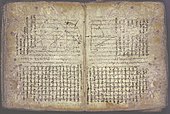
Eratosthenes of Alexandria (c. 276 BC – c. 195/194 BC), wrote on astronomy and geography, simply his work is known mainly from later summaries. He is credited with being the outset person to measure the Earth'due south circumference. Much that was written by the mathematicians Euclid and Archimedes has been preserved. Euclid is known for his Elements, much of which was drawn from his predecessor Eudoxus of Cnidus. The Elements is a treatise on geometry, and it has exerted a standing influence on mathematics. From Archimedes several treatises have come down to the present. Among them are Measurement of the Circle, in which he worked out the value of pi; The Method of Mechanical Theorems, on his work in mechanics; The Sand Calculator; and On Floating Bodies. A manuscript of his works is currently being studied.[87]
Prose fiction [edit]
Very trivial has survived of prose fiction from the Hellenistic Era. The Milesiaka by Aristides of Miletos was probably written during the 2d century BC. The Milesiaka itself has not survived to the present solar day in its complete form, merely various references to it accept survived. The book established a whole new genre of so-called "Milesian tales," of which The Gilt Ass by the subsequently Roman writer Apuleius is a prime number example.[88] [89]
The ancient Greek novels Chaereas and Callirhoe [90] by Chariton and Metiochus and Parthenope [91] [92] were probably both written during the late showtime century BC or early first century AD, during the latter part of the Hellenistic Era. The discovery of several fragments of Lollianos's Phoenician Tale reveal the being of a genre of aboriginal Greek picaresque novel.[93]
Roman period [edit]
While the transition from city-country to empire affected philosophy a swell deal, shifting the accent from political theory to personal ethics, Greek letters continued to flourish both under the Successors (peculiarly the Ptolemies) and nether Roman rule. Romans of literary or rhetorical inclination looked to Greek models, and Greek literature of all types continued to exist read and produced both by native speakers of Greek and later by Roman authors also. A notable feature of this catamenia was the expansion of literary criticism as a genre, particularly equally exemplified by Demetrius, Pseudo-Longinus and Dionysius of Halicarnassus. The New Testament, written by various authors in varying qualities of Koine Greek also hails from this period,[94] [8] : 208–209 the most important works being the Gospels and the Epistles of Saint Paul.[95] [eight] : 208–213
Poetry [edit]
The poet Quintus of Smyrna, who probably lived during the late fourth century AD,[96] [97] wrote Posthomerica, an epic poem narrating the story of the fall of Troy, beginning where The Iliad left off.[98]
The poet Nonnus of Panopolis wrote The Dionysiaca, the longest surviving epic verse form from antiquity. He also wrote a poetic paraphrase of The Gospel of John.[99] [100] Nonnus probably lived quondam during the late 4th century Advert or early fifth century Advertizement.[101] [102]
Historiography [edit]
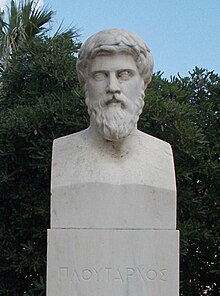
A bust of Plutarch, ane of the nigh famous aboriginal Greek historians, from his hometown of Chaeronea
The historian Polybius was born about 200 BC. He was brought to Rome as a hostage in 168. In Rome he became a friend of the general Scipio Aemilianus. He probably accompanied the general to Kingdom of spain and North Africa in the wars confronting Carthage. He was with Scipio at the devastation of Carthage in 146.[103]
Diodorus Siculus was a Greek historian who lived in the 1st century BC, around the time of Julius Caesar and Augustus. He wrote a universal history, Bibliotheca Historica, in twoscore books. Of these, the first five and the 11th through the 20th remain. The first two parts covered history through the early Hellenistic era. The third function takes the story to the beginning of Caesar's wars in Gaul, at present France.[104] Dionysius of Halicarnassus lived late in the get-go century BC. His history of Rome from its origins to the First Punic War (264 to 241 BC) is written from a Roman signal of view, but it is carefully researched. He also wrote a number of other treatises, including On Fake, Commentaries on the Ancient Orators, and On the Arrangement of Words.[105]
The historians Appian of Alexandria and Arrian of Nicomedia both lived in the 2nd century AD.[106] [107] Appian wrote on Rome and its conquests, while Arrian is remembered for his work on the campaigns of Alexander the Nifty. Arrian served in the Roman regular army. His book therefore concentrates heavily on the war machine aspects of Alexander's life. Arrian besides wrote a philosophical treatise, the Diatribai, based on the teachings of his mentor Epictetus.
Best known of the late Greek historians to modern readers is Plutarch of Chaeronea, who died about AD 119. His Parallel Lives of great Greek and Roman leaders has been read by every generation since the work was first published. His other surviving work is the Moralia, a collection of essays on upstanding, religious, political, physical, and literary topics.[108] [109]
During subsequently times, so-called "commonplace books," commonly describing historical anecdotes, became quite popular. Surviving examples of this pop genre include works such equally Aulus Gellius's Attic Nights,[110] Athenaeus of Naucratis's Deipnosophistae,[111] and Claudius Aelianus'south De Natura Animalium and Varia Historia.[112]
Science and mathematics [edit]

The physician Galen lived during the 2d century Advertising. He was a conscientious student of anatomy, and his works exerted a powerful influence on medicine for the side by side 1,400 years. Strabo, who died near AD 23, was a geographer and historian. His Historical Sketches in 47 volumes has about all been lost. His Geographical Sketches remain as the simply existing ancient volume covering the whole range of people and countries known to the Greeks and Romans through the time of Augustus.[113] Pausanias, who lived in the 2nd century Ad, was also a geographer.[114] His Clarification of Greece is a travel guide describing the geography and mythic history of Greece during the second century. The book takes the class of a tour of Greece, starting in Athens and ending in Naupactus.[115]
The scientist of the Roman menses who had the greatest influence on after generations was undoubtedly the astronomer Ptolemy. He lived during the 2nd century AD,[116] though trivial is known of his life. His masterpiece, originally entitled The Mathematical Collection, has come up to the present nether the title Almagest, every bit information technology was translated past Arab astronomers with that championship.[117] It was Ptolemy who devised a detailed description of an Earth-centered universe,[118] a notion that dominated astronomical thinking for more than than 1,300 years.[119] The Ptolemaic view of the universe endured until Copernicus, Galileo, Kepler, and other early modern astronomers replaced it with heliocentrism.[120]
Philosophy [edit]
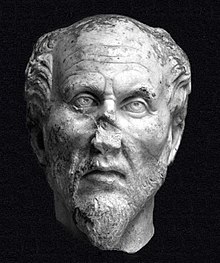
Head of Plotinus, a major philosopher from the Roman Era
Epictetus (c. 55 AD – 135 Advertisement) was associated with the moral philosophy of the Stoics. His teachings were collected by his pupil Arrian in the Discourses and the Encheiridion (Transmission of Study).[121]
Diogenes Laërtius, who lived in the third century AD, wrote Lives and Opinions of Eminent Philosophers, a voluminous collection of biographies of nearly every Greek philosopher who ever lived. Unfortunately, Diogenes Laërtius often fails to cite his sources and many modern historians consider his testimony unreliable.[122] Yet, in spite of this, he remains the only available source on the lives of many early on Greek philosophers.[123] His book is not entirely without merit; it does preserve a tremendous wealth of information that otherwise would not have been preserved. His biography of Epicurus, for case, is of particularly high quality and contains three lengthy letters attributed to Epicurus himself, at least two of which are generally agreed to be authentic.[124]
Another major philosopher of his menstruation was Plotinus. He transformed Plato's philosophy into a schoolhouse chosen Neoplatonism.[125] His Enneads had a broad-ranging influence on European thought until at least the seventeenth century.[126] Plotinus's philosophy mainly revolved around the concepts of nous, psyche, and the "1."[127]
After the rising of Christianity, many of the most of import philosophers were Christians. The second-century Christian apologist Justin Martyr, who wrote exclusively in Greek, made extensive use of ideas from Greek philosophy, especially Platonism.[128] Origen of Alexandria, the founder of Christian theology,[129] also made extensive use of ideas from Greek philosophy[130] and was even able to concord his own against the infidel philosopher Celsus in his apologetic treatise Contra Celsum.[131]
Prose fiction [edit]
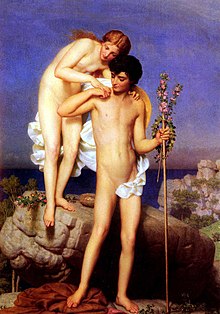
The Roman Flow was the time when the majority of extant works of Greek prose fiction were equanimous. The ancient Greek novels Leucippe and Clitophon by Achilles Tatius[132] [133] and Daphnis and Chloe by Longus[134] were both probably written during the early 2d century Advert. Daphnis and Chloe, by far the almost famous of the five surviving ancient Greek romance novels, is a nostalgic tale of two immature lovers growing up in an arcadian pastoral surroundings on the Greek isle of Lesbos.[135] The Wonders Across Thule by Antonius Diogenes may take likewise been written during the early on second century AD, although scholars are unsure of its exact date. The Wonders Beyond Thule has not survived in its complete grade, but a very lengthy summary of information technology written by Photios I of Constantinople has survived.[136] The Ephesian Tale by Xenophon of Ephesus was probably written during the late second century AD.[134]

The satirist Lucian of Samosata lived during the tardily 2d century AD. Lucian's works were incredibly popular during antiquity. Over eighty different writings attributed to Lucian have survived to the present day.[137] About all of Lucian's works are written in the heavily Atticized dialect of ancient Greek language prevalent amidst the well-educated at the time. His book The Syrian Goddess, still, was written in a fake-Ionic dialect, deliberately imitating the dialect and style of Herodotus.[138] [139] Lucian's almost famous work is the novel A True Story, which some authors have described as the primeval surviving work of science fiction.[140] [141] His dialogue The Lover of Lies contains several of the earliest known ghost stories[142] as well equally the earliest known version of "The Wizard'due south Amateur."[143] His letter The Passing of Peregrinus, a ruthless satire against Christians, contains i of the earliest pagan appraisals of early on Christianity.[144]
The Aethiopica by Heliodorus of Emesa was probably written during the third century AD.[145] It tells the story of a immature Ethiopian princess named Chariclea, who is estranged from her family and goes on many misadventures across the known world.[146] Of all the aboriginal Greek novels, the one that attained the greatest level of popularity was the Alexander Romance, a fictionalized account of the exploits of Alexander the Great written in the third century AD. Lxxx versions of it have survived in xx-iv different languages, attesting that, during the Middle Ages, the novel was well-nigh as popular every bit the Bible.[147] : 650–654 Versions of the Alexander Romance were so commonplace in the fourteenth century that Geoffrey Chaucer wrote that "...every wight that hath discrecioun / Hath herd somwhat or al of [Alexander's] fortune."[147] : 653–654
Legacy [edit]
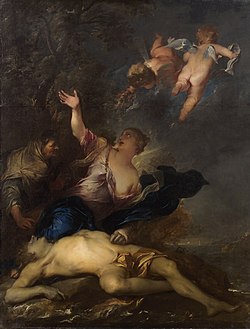
Ancient Greek literature has had an enormous touch on on western literature equally a whole.[148] Ancient Roman authors adopted various styles and motifs from ancient Greek literature. These ideas were later, in turn, adopted by other western European writers and literary critics.[148] Aboriginal Greek literature peculiarly influenced later Greek literature. For instance, the Greek novels influenced the later work Hero and Leander, written by Musaeus Grammaticus.[149] Ancient Roman writers were acutely aware of the ancient Greek literary legacy and many deliberately emulated the style and formula of Greek classics in their own works. The Roman poet Vergil, for instance, modeled his ballsy poem the Aeneid on the Iliad and the Odyssey.[150]
During the Middle Ages, ancient Greek literature was largely forgotten in Western Europe. The medieval author Roger Bacon wrote that "there are not four men in Latin Christendom who are acquainted with the Greek, Hebrew, and Arabic grammars."[151] It was not until the Renaissance that Greek writings were rediscovered by western European scholars.[152] During the Renaissance, Greek began to exist taught in western European colleges and universities for the first time, which resulted in western European scholars rediscovering the literature of aboriginal Greece.[153] The Textus Receptus, the first New Testament printed in the original Greek, was published in 1516 past the Dutch humanist scholar Desiderius Erasmus.[154] Erasmus also published Latin translations of classical Greek texts, including a Latin translation of Hesiod'south Works and Days.[155]

The influence of classical Greek literature on modernistic literature is also evident. Numerous figures from classical literature and mythology appear throughout The Divine One-act by Dante Alighieri.[156] Plutarch's Lives were a major influence on William Shakespeare and served equally the main source behind his tragedies Julius Caesar, Antony and Cleopatra, and Coriolanus.[157] : 883–884 Shakespeare's comedies A Comedy of Errors and The Twelfth Dark drew heavily on themes from Graeco-Roman New Comedy.[157] : 881–882 Meanwhile, Shakespeare'due south tragedy Timon of Athens was inspired by a story written by Lucian[158] and his comedy Pericles, Prince of Tyre was based on an accommodation of the aboriginal Greek novel Apollonius of Tyre found in John Gower's Confessio Amantis.[159]
John Milton's epic poem Paradise Lost is written using a similar style to the two Homeric epics.[160] Information technology also makes frequent allusions to figures from classical literature and mythology, using them as symbols to convey a Christian message.[161] Lucian'southward A Truthful Story was role of the inspiration for Jonathan Swift'due south novel Gulliver's Travels.[157] : 545 Bulfinch'southward Mythology, a book on Greek mythology published in 1867 and aimed at a pop audience, was described by Carl J. Richard equally "one of the most popular books ever published in the United States".[162]
George Bernard Shaw's play Pygmalion is a modern, rationalized retelling of the ancient Greek legend of Pygmalion.[157] : 794 James Joyce's novel Ulysses, heralded by critics as i of the greatest works of modernistic literature,[163] [164] is a retelling of Homer's Odyssey gear up in modern-24-hour interval Dublin.[165] [166] The mid-twentieth-century British author Mary Renault wrote a number of critically acclaimed novels inspired by ancient Greek literature and mythology, including The Last of the Wine and The King Must Die.[167]
Even in works that exercise non consciously describe on Graeco-Roman literature, authors frequently employ concepts and themes originating in ancient Greece. The ideas expressed in Aristotle'south Poetics, in particular, have influenced generations of Western writers and literary critics.[168] A Latin translation of an Arabic version of the Poetics by Averroes was available during the Middle Ages.[169] Common Greek literary terms still used today include: catharsis,[170] ethos,[171] anagnorisis,[172] hamartia,[173] hubris,[174] mimesis,[175] mythos,[176] nemesis,[177] and peripeteia.[178]
Notes [edit]
- ^ Although Sophocles won second prize with the group of plays that included Oedipus Rex, its date of production is uncertain. The prominence of the Theban plague at the play'south opening suggests to many scholars a reference to the plague that devastated Athens in 430 BC, and hence a production date soon thereafter. Run across, for example, Knox, Bernard (1956). "The Date of the Oedipus Tyrannus of Sophocles". American Journal of Philology. 77 (2): 133–147. doi:10.2307/292475. JSTOR 292475.
- ^ Simplicius, Comments on Aristotle's Physics (24, thirteen):
- " Ἀναξίμανδρος [...] λέγει δ' αὐτὴν μήτε ὕδωρ μήτε ἄλλο τι τῶν καλουμένων εἶναι στοιχείων, ἀλλ' ἑτέραν τινὰ φύσιν ἄπειρον, ἐξ ἧς ἅπαντας γίνεσθαι τοὺς οὐρανοὺς καὶ τοὺς ἐν αὐτοῖς κόσμους· ἐξ ὧν δὲ ἡ γένεσίς ἐστι τοῖς οὖσι, καὶ τὴν φθορὰν εἰς ταῦτα γίνεσθαι κατὰ τὸ χρεών· διδόναι γὰρ αὐτὰ δίκην καὶ τίσιν ἀλλήλοις τῆς ἀδικίας κατὰ τὴν τοῦ χρόνου τάξιν, ποιητικωτέροις οὕτως ὀνόμασιν αὐτὰ λέγων. δῆλον δὲ ὅτι τὴν εἰς ἄλληλα μεταβολὴν τῶν τεττάρων στοιχείων οὗτος θεασάμενος οὐκ ἠξίωσεν ἕν τι τούτων ὑποκείμενον ποιῆσαι, ἀλλά τι ἄλλο παρὰ ταῦτα· οὗτος δὲ οὐκ ἀλλοιουμένου τοῦ στοιχείου τὴν γένεσιν ποιεῖ, ἀλλ' ἀποκρινομένων τῶν ἐναντίων διὰ τῆς αἰδίου κινήσεως. "
References [edit]
- ^ "Lucian | Greek writer". Encyclopedia Britannica . Retrieved 2021-08-03 .
Lucian [...] ancient Greek rhetorician, pamphleteer, and satirist.
{{cite web}}: CS1 maint: url-status (link) - ^ Chadwick, John (1967). The Decipherment of Linear B (Second ed.). Cambridge, England: Cambridge University Printing. p. 101. ISBN978-1-107-69176-6. "The glimpse we accept suddenly been given of the account books of a long-forgotten people..."
- ^ a b c Ventris, Michael; Chadwick, John (1956). Documents in Mycenaean Greek. Cambridge, England: Cambridge University Printing. p. xxix. ISBN978-ane-107-50341-0.
- ^ Heath, Malcolm, ed. (1997). Aristotle'southward Poetics . Penguin Books. ISBN0-fourteen-044636-2.
- ^ Grendler, Paul F (2004). The Universities of the Italian Renaissance. Johns Hopkins University Press. p. 239. ISBN0-8018-8055-6.
- ^ Frow, John (2007). Genre (Reprint ed.). Routledge. pp. 57–59. ISBN978-0-415-28063-i.
- ^ a b c Engels, Johannes (2008). "Chapter Ten: Universal History and Cultural Geography of the Oikoumene in Herodotus' Historiai and Strabo's Geographika". In Pigoń, Jakub (ed.). The Children of Herodotus: Greek and Roman Historiography and Related Genres. Newcastle upon Tyne, England: Cambridge Scholar Publishing. p. 146. ISBN978-one-4438-0015-0.
- ^ a b c d e f g h i Jenkyns, Richard (2016). Classical Literature: An Epic Journey from Homer to Virgil and Beyond. New York City, New York: Basic Books, A Member of the Perseus Books Group. ISBN978-0-465-09797-5.
- ^ Lattimore, Richmond (2011). The Iliad of Homer. The University of Chicago Press, Ltd., London: The University of Chicago Printing. Book 1, Line number 155 (p. 79). ISBN978-0-226-47049-8.
- ^ Guy Hedreen, "The Cult of Achilles in the Euxine" Hesperia 60.3 (July 1991), pp. 313–330.
- ^ Stanford, William Bedell (1959) [1947]. "Introduction, Grammatical Introduction". Homer: Odyssey I-XII. Vol. ane (second ed.). Macmillan Pedagogy. pp. nine–lxxxvi. ISBN1-85399-502-9.
- ^ Harris, William. "The Greek Dactylic Hexameter: A Practical Reading Approach". Middlebury College. Retrieved 12 March 2017.
- ^ a b Thousand. Hadas (2013-08-xiii). A History of Greek Literature (p.16). published by Columbia University Printing 13 Aug 2013, 327 pages. ISBN978-0-231-51486-6 . Retrieved 2015-09-08 .
- ^ J.P. Barron and P.E. Easterling, "Hesiod" in The Cambridge History of Classical Literature: Greek Literature, P. Easterling and B. Knox (eds), Cambridge University Press (1985), page 92
- ^ West, K. Fifty. Theogony. Oxford University Press (1966), page 40
- ^ Jasper Griffin, "Greek Myth and Hesiod", J. Boardman, J. Griffin and O. Murray (eds), The Oxford History of the Classical World, Oxford University Press (1986), page 88
- ^ Cartwright, Mark. "Greek Faith". World History Encyclopedia . Retrieved 17 January 2017. "... These traditions were first recounted only orally as in that location was no sacred text in Greek religion and later, attempts were made to put in writing this oral tradition, notably by Hesiod in his Theogony and more indirectly in the works of Homer.
- ^ J. P. Barron and P. E. Easterling, 'Elegy and Iambus', in The Cambridge History of Classical Literature: Greek Literature, P. Easterling and B. Knox (ed.s), Cambridge University Printing (1985), page 117
- ^ David A. Campbell, Greek Lyric Poetry, Bristol Classical Press (1982) page 136
- ^ J. M. Edmonds - Lyra Graeca (p.three) Wildside Press LLC, 2007 ISBN 1-4344-9130-vii [Retrieved 2015-05-06]
- ^ Hallett, Judith P. (1979). "Sappho and her Social Context: Sense and Sensuality". Signs. iv (iii).
- ^ Rayor, Diane; Lardinois, André (2014). Sappho: A New Edition of the Complete Works. Cambridge: Cambridge University Press. ISBN 978-ane-107-02359-8.
- ^ Pausanias 3.15.2 Ἀλκμᾶνι ποιήσαντι ἄισματα οὐδὲν ἐς ἡδονὴν αὐτῶν ἐλυμήνατο τῶν Λακῶνων ἡ γλῶσσα ἥκιστα παρεχομένη τὸ εὔφωνον .
- ^ Grand. Davies's "Monody, Choral Lyric, and the Tyranny of the Hand-Book" in Classical Quarterly, NS 38 (1988), pp. 52–64.
- ^ a b c Garland, Robert (2008). Ancient Greece: Everyday Life in the Birthplace of Western Civilization. New York City, New York: Sterling. p. 284. ISBN978-i-4549-0908-8.
- ^ Buckham, Philip Wentworth, Theatre of the Greeks, Cambridge : J. Smith, 1827.
- ^ Garland, Robert (2008). Ancient Hellenic republic: Everyday Life in the Birthplace of Western Civilisation. New York City, New York: Sterling. p. 290. ISBN978-one-4549-0908-8.
- ^ Garland, Robert (2008). Ancient Hellenic republic: Everyday Life in the Birthplace of Western Civilization. New York City, New York: Sterling. pp. 284–296. ISBN978-one-4549-0908-8.
- ^ Griffith, Marking. The Authenticity of the Prometheus Bound. Cambridge, 1977.
- ^ Walton, J. Michael, Euripides Our Contemporary, University of California Printing, 2009, ISBN 0-520-26179-8.
- ^ Shush, Kenneth (1952). "Form and Persecution in the Oresteia". The Sewanee Review. threescore (3: July – September): 377–396. JSTOR 27538150.
- ^ Due west, M.50. Studies in Aeschylus. Stuttgart, 1990.
- ^ Suda (ed. Finkel et al.): s.v. Σοφοκλῆς.
- ^ Fagles, Robert (1986). The 3 Theban Plays. New York: Penguin. p. 35.
- ^ Pomeroy, Sarah; Burstein, Stanley; Donlan, Walter; Roberts, Jennifer (1999). Ancient Greece: A Political, Social, and Cultural History. New York: Oxford University Press. p. 322. ISBN0-19-509742-4.
- ^ B. Knox,'Euripides' in The Cambridge History of Classical Literature I: Greek Literature, P. Easterling and B. Knox (ed.southward), Cambridge Academy Press (1985), page 316
- ^ Walton (1997, eight, xix)
- ^ B. Knox. "Euripides" in The Cambridge History of Classical Literature I: Greek Literature, P. Easterling and B. Knox (ed.s), Cambridge University Printing (1985), page 339
- ^ Banham, Martin, ed. 1998. The Cambridge Guide to Theatre. Cambridge: Cambridge University Press. ISBN 0-521-43437-viii.
- ^ Brockett, Oscar G. and Franklin J. Hildy. 2003. History of the Theatre. Ninth edition, International edition. Boston: Allyn and Salary. ISBN 0-205-41050-2.
- ^ Aristophanes: Clouds K.J. Dover (ed), Oxford University Press 1970, Intro. folio 10.
- ^ David Barrett'south edition Aristophanes: the Frogs and Other Plays (Penguin Classics, 1964), p. 13
- ^ Roche, Paul (2005). Aristophanes: The Complete Plays: A New Translation by Paul Roche. New York: New American Library. pp. x–xi. ISBN978-0-451-21409-six.
- ^ Roche, Paul (2005). Aristophanes: The Complete Plays: A New Translation by Paul Roche. New York: New American Library. pp. 537–540. ISBN978-0-451-21409-6.
- ^ Garland, Robert (2008). Ancient Greece: Everyday Life in the Birthplace of Western Civilisation. New York City, New York: Sterling. p. 288. ISBN978-1-4549-0908-viii.
- ^ Hall, Edith; Wrigley, Amanda (2007). Aristophanes in Performance, 421 BC-Ad 2007: Peace, Birds and Frogs. ISBN9781904350613 . Retrieved 5 April 2011.
- ^ Euripides. McHugh, Heather, trans. Cyclops; Greek Tragedy in New Translations. Oxford Univ. Press (2001) ISBN 978-0-19-803265-6
- ^ Hunt, A.S. (1912) The Oxyrhynchus Papyri: Part Nine. London.
- ^ T. James Luce, The Greek Historians, 2002, p. 26.
- ^ Procopius, John Moorhead, Encyclopedia of Historians and Historical Writing: M–Z, Vol. Two, Kelly Boyd, (Fitzroy Dearborn Publishers, 1999), 962
- ^ Xenophon, Hellenica seven.v.27; Xenophon. Xenophontis opera omnia, vol. 1. Oxford, Clarendon Press. 1900, repr. 1968
- ^ Danzig, Gabriel. 2003. "Apologizing for Socrates: Plato and Xenophon on Socrates' Behavior in Court." Transactions of the American Philological Association. Vol. 133, No. ii, pp. 281–321.
- ^ G. Due south. Kirk and J. E. Raven and K. Schofield, The Presocratic Philosophers (Cambridge University Press, 1983, 108–109.
- ^ Curd, Patricia, A Presocratics Reader: Selected Fragments and Testimonia (Hackett Publishing, 1996), p. 12.
- ^
 One or more of the preceding sentences incorporates text from a publication at present in the public domain:Smith, William, ed. (1870). "Pythagoras". Dictionary of Greek and Roman Biography and Mythology. pp. 616–625.
 - ^ Simon Trépanier, (2004), Empedocles: An Interpretation, Routledge.
- ^ Kahn, Charles H. (1979). The Fine art and Thought of Heraclitus. An Edition of the Fragments with Translation and Commentary. Cambridge: Cambridge Academy Printing. ISBN0-521-21883-7.
- ^ Berryman, Sylvia. "Democritus". Stanford Encyclopedia of Philosophy. Stanford University. Retrieved 25 March 2017.
- ^ Kofman, Sarah (1998). Socrates: Fictions of a Philosopher. p. 34. ISBN0-8014-3551-X.
- ^ Cohen, M., Philosophical Tales: Being an Alternative History Revealing the Characters, the Plots, and the Hidden Scenes that Brand Up the True Story of Philosophy, John Wiley & Sons, 2008, p. five, ISBN 1-4051-4037-2.
- ^ Rubel, A.; Vickers, M. (11 September 2014). Fear and Loathing in Ancient Athens: Faith and Politics During the Peloponnesian State of war. Routledge. p. 147. ISBN978-1-317-54480-7.
- ^ Dorion, Louis-André (2011). The Ascent and Autumn of the Socratic Problem (pp. 1–23) (The Cambridge Companion to Socrates). Cambridge Academy Press. doi:10.1017/CCOL9780521833424.001. hdl:10795/1977. ISBN978-0-521-83342-4 . Retrieved 2015-05-07 .
- ^ Henri Estienne (ed.), Platonis opera quae extant omnia, Vol. ane, 1578, p. 17.
- ^ Lorenz, Hendrik (22 April 2009). "Ancient Theories of Soul". Stanford Encyclopedia of Philosophy. Retrieved 2013-12-x .
- ^ Plato, The Symposium. Translation and introduction by Walter Hamilton. Penguin Classics. 1951. ISBN 978-0-14-044024-9
- ^ National Public Radio (August 8, 2007). Plato'south 'Republic' Still Influential, Author Says. Talk of the Nation.
- ^ Plato: The Republic. Plato: His Philosophy and his life, allphilosophers.com
- ^ Baird, Forrest Due east.; Walter Kaufmann (2008). From Plato to Derrida. Upper Saddle River, New Jersey: Pearson Prentice Hall. ISBN978-0-13-158591-i.
- ^ Magee, Bryan (2010). The Story of Philosophy. Dorling Kindersley. p. 34.
- ^ Morison, William (2006). "The Lyceum". Internet Encyclopedia of Philosophy . Retrieved 30 October 2009.
- ^ "Great Philosophers: Aristotle (384-322 BCE)". Slap-up Philosophers. Oregon Land University. Retrieved 23 June 2017.
- ^ Bury, J. B. (1937). A History of Greece to the Expiry of Alexander the Groovy . New York: Modern Library. pp. 668–723.
- ^ Bury, J. B. (1937). A History of Hellenic republic to the Death of Alexander the Great . New York: Mod Library. pp. 724–821.
- ^ Entry Μουσείον at Liddell & Scott
- ^ Phillips, Heather A. (Baronial 2010). "The Great Library of Alexandria?". Library Philosophy and Practise. ISSN 1522-0222. Archived from the original on 2012-04-18. Retrieved 2017-05-17 .
- ^ Introduction (p.14) to Virgil: The Eclogues trans. Guy Lee (Penguin Classics)
- ^ Commodity on "Bucolic poetry" in The Oxford Companion to Classical Literature (1989)
- ^ a b c d eastward f g Harder, Annette (2012). Callimachus: Aetia. Oxford, England: Oxford University Press. pp. 1–v. ISBN978-0-19-958101-6.
- ^ Nisetich, Frank (2001). The Poems of Callimachus. Oxford, England: Oxford University Press. pp. eighteen–xx. ISBN0-19814760-0 . Retrieved 27 July 2017.
- ^ Blum 1991, p. 236, cited in Phillips, Heather A. (August 2010). "The Bang-up Library of Alexandria?". Library Philosophy and Practise. ISSN 1522-0222. Archived from the original on 2012-04-xviii. Retrieved 2017-05-17 .
- ^ Stephens, Susan (2011), "Ptolemaic Ballsy", in T. Papaghelis; A. Rengakos (eds.), Brill's Companion to Apollonius Rhodius; Second (Revised ed.), Brill
- ^ A. W. Mair and Thou. R. Mair, trans., Callimachus and Lycophron; Aratus, Loeb Classical Library (New York: G. P. Putnam's Sons, 1921), p. 363
- ^ Konstan, David (2010). Menander of Athens. Oxford: Oxford Academy Press. pp. 3–6. ISBN 0-19-980519-9.
- ^ Businesswoman, Christopher A. (2013). Timaeus of Tauromenium and Hellenistic Historiography. Cambridge University Press.
- ^ Brown, Truesdell S. (1958). Timaeus of Tauromenium. Berkeley: University of California Press.
- ^ Marincola, John, ed. A companion to Greek and Roman historiography. John Wiley & Sons, 2010, 528-531.
- ^ Bergmann, Uwe. "X-Ray Fluorescence Imaging of the Archimedes Palimpsest: A Technical Summary" (PDF) . Retrieved 2013-09-29 .
- ^ Walsh, P.G. (1968). "Lucius Madaurensis". Phoenix. 22 (2): 143–157. doi:10.2307/1086837. JSTOR 1086837.
- ^ Apuleius Madaurensis, Lucius; trans. Lindsay, Jack (1960). The Golden Ass. Bloomington, Indiana: Indiana University Press. p. 31. ISBN0-253-20036-9.
- ^ Edmund P. Cueva (Fall 1996). "Plutarch'southward Ariadne in Chariton'southward Chaereas and Callirhoe". American Journal of Philology. 117 (3): 473–484. doi:x.1353/ajp.1996.0045.
- ^ Cf. Thomas Hägg, 'The Oriental Reception of Greek Novels: A Survey with Some Preliminary Considerations', Symbolae Osloenses, 61 (1986), 99–131 (p. 106), doi:10.1080/00397678608590800.
- ^ Thomas Hägg and Bo Utas, The Virgin and Her Lover: Fragments of an Ancient Greek Novel and a Persian Epic Poem. Brill Studies in Center Eastern Literatures, 30 (Leiden: Brill, 2003), p. ane.
- ^ Reardon, Bryan P. (1989). Collected Ancient Greek Novels. Berkeley: University of California Press. pp. 809–810. ISBN0-520-04306-five . Retrieved 31 May 2017.
- ^ Metzger, Bruce M. (1987). The Canon of the New Attestation: Its Origin, Evolution, and Significance (PDF). pp. 295–296. ISBN0-xix-826180-two. Archived from the original (PDF) on 2013-06-01.
- ^ Trobisch, David (1994). Paul's Letter Drove: Tracing the Origins. pp. ane–27. ISBN0-8006-2597-8.
- ^ Thomas Christian Tychsen, Quinti Smyrnaei Posthomericorum libri 14. Nunc primum advertisement librorum manoscriptorum fidem et virorum doctorum coniecturas recensuit, restituit et supplevit Thom. Christ. Tychsen acceserunt observationes Chr. Gottl. Heynii (Strassburg: Typhographia Societatis Bipontinae) 1807.
- ^ Armin H. Köchly, Quinti Smyrnaei Posthomericorum libri Fourteen. Recensuit, prolegomenis et adnotatione critica instruxit Arminius Koechly (Leipzig: Weidmannos) 1850.
- ^ A.S. Manner, Introduction 1913.
- ^ Vian, Francis. '"Mârtus" chez Nonnos de Panopolis. Étude de sémantique et de chronologie.' REG 110, 1997, 143-lx. Reprinted in: 50'Épopée posthomérique. Recueil d'études. Ed. Domenico Accorinti. Alessandria: Edizioni dell'Orso, 2005 (Hellenica 17), 565-84
- ^ Cameron, Alan, 2015. Wandering Poets and Other Essays on Late Greek Literature and Philosophy. Oxford University Printing. p.81.
- ^ Agathias Scholasticus, Hist. 4.23. (530x 580)
- ^ Fornaro, S. s.v. Nonnus in Brill'due south New Pauly vol. 9 (ed. Canick & Schneider) (Leiden, 2006) col.812–815
- ^ "Titus Livius (Livy), The History of Rome, Book 39, chapter 35". world wide web.perseus.tufts.edu . Retrieved 2016-11-02 .
- ^ Sacks, Kenneth S. (1990). Diodorus Siculus and the Beginning Century. Princeton University Press. ISBN 0-691-03600-4.
- ^ T. Hidber. Encyclopedia of Ancient Greece (p.229). Routledge 31 Oct 2013, 832 pages, ISBN one-136-78799-2, (editor N. Wilson). Retrieved 2015-09-07.
- ^ White, Horace (1912). "Introduction". Appian'southward Roman History. Cambridge, Mass: The Loeb Classical Library. pp. vii–xii. ISBN0-674-99002-1.
- ^ FW Walbank (November 1984). F. Westward. Walbank (ed.). The Cambridge Ancient History. Cambridge Academy Press, 6 Sep 1984. ISBN0-521-23445-X . Retrieved 2015-04-01 .
- ^ "Plutarch". Oxford Dictionary of Philosophy.
- ^ Stadter, Philip A. (2015). Plutarch and His Roman Readers. Oxford University Press. p. 69. ISBN 978-0-19-871833-viii. Retrieved 2015-02-04. Although Plutarch wrote in Greek and with a Greek point of view, [...] he was thinking of a Roman as well as a Greek audience.
- ^ Ramsay, William (1867), "A. Gellius", in Smith, William, Dictionary of Greek and Roman Biography and Mythology, 2, Boston, p. 235
- ^ Ἀθήναιος [Athenaeus]. Δειπνοσοφισταί [Deipnosophistaí, Sophists at Dinner], c. tertiary century (Ancient Greek) Trans. Charles Burton Gulick as Athenaeus, Vol. I, p. viii. Harvard University Press (Cambridge), 1927. Accessed xiii Aug 2014.
- ^ Aelian, Historical Miscellany. Translated by Nigel Thou. Wilson. 1997. Loeb Classical Library. ISBN 978-0-674-99535-2
- ^ Dueck, Daniela (2000). Strabo of Amasia: A Greek Man of Letters in Augustan Rome. London, New York: Routledge: Taylor & Francis Group. p. 145. ISBN0-415-21672-nine.
- ^ Historical and Ethnological Order of Greece, Aristéa Papanicolaou Christensen, The Panathenaic Stadium – Its History Over the Centuries (2003), p. 162
- ^ Pausanias. Description of Greece: Complete. First Charge per unit Publishers. ISBN978-1-5028-8547-0.
- ^ "Ptolemy | Accomplishments, Biography, & Facts". Encyclopedia Britannica . Retrieved 2016-03-06 .
- ^ A. I. Sabra, "Configuring the Universe: Aporetic, Problem Solving, and Kinematic Modeling as Themes of Arabic Astronomy," Perspectives on Science 6.3 (1998): 288–330, at pp. 317–eighteen
- ^ NT Hamilton, N. Yard. Swerdlow, G. J. Toomer. "The Canobic Inscription: Ptolemy's Earliest Work". In Berggren and Goldstein, eds., From Ancient Omens to Statistical Mechanics. Copenhagen: Academy Library, 1987.
- ^ Fraser, Craig K. (2006). The Cosmos: A Historical Perspective. p. xiv.
- ^ Lattis, James L. (1995). Between Copernicus and Galileo: Christoph Clavius and the Collapse of Ptolemaic Cosmology, University of Chicago Printing, pgs 186–190
- ^ Epictetus, Discourses, prologue.
- ^ Long, Herbert S. (1972). Introduction. Lives of Eminent Philosophers. By Laërtius, Diogenes. Vol. i (reprint ed.). Loeb Classical Library. p. xvi.
- ^ "Diogenes Laërtius", The Columbia Electronic Encyclopedia, 2013
- ^
 Laërtius, Diogenes (1925c). . Lives of the Eminent Philosophers. Vol. 2:10. Translated by Hicks, Robert Drew (Two volume ed.). Loeb Classical Library.
 - ^ Philip Merlan, From Platonism to Neoplatonism (The Hague: Martinus Nijhoff, 1954, 1968), p. 3.
- ^ Detlef Thiel: Die Philosophie des Xenokrates im Kontext der Alten Akademie, München 2006, pp. 197ff. and note 64; Jens Halfwassen: Der Aufstieg zum Einen.
- ^ "Who was Plotinus?".
- ^ New Schaff-Herzog Encyclopedia of Religious Knowledge tertiary ed. 1914. Pg 284
- ^ Moore, Edward. "Origen of Alexandria (entry in the Internet Encyclopedia of Philosophy)". The Net Encyclopedia of Philosophy. IEP. ISSN 2161-0002. Retrieved 2014-04-27 .
- ^ Schaff, Philip (1910). The new Schaff-Herzog encyclopedia of religious knowledge: embracing biblical, historical, doctrinal, and practical theology and biblical, theological, and ecclesiastical biography from the primeval times to the present twenty-four hour period. Funk and Wagnalls Company. p. 272. Retrieved 2014-07-30 .
- ^ Herzog, Johann Jakob; Philip Schaff; Albert Hauck (December 1908). "Celsus". In Samual Macauley Jackson (ed.). The New Schaff-Herzog Encyclopedia of Religious Knowledge. Vol. 2. New York and London: Funk and Wagnalls Visitor. p. 466.
- ^ The "early dating of P.Oxy 3836 holds, Achilles Tatius' novel must have been written 'nearer 120 than 150'" Albert Henrichs, Culture In Pieces: Essays on Ancient Texts in Honor of Peter Parsons, eds. Dirk Obbink, Richard Rutherford, Oxford University Press, 2011, p. 309, n. 29 ISBN 0-19-929201-9, 9780199292011
- ^ "the utilize (albeit mid and erratic) of the Attic dialect suggest a date a little earlier [than mid-2nd century] in the same century." The Greek Novel: Oxford Bibliographies Online Research Guide Oxford University Printing, 2010, p. 7 ISBN 0-19-980303-X, 9780199803033
- ^ a b Longus; Xenophon of Ephesus (2009), Henderson, Jeffery, ed., Anthia and Habrocomes (translation), Cambridge, Massachusetts: Harvard University Press, pp. 69 & 127, ISBN 978-0-674-99633-5
- ^ Richard Hunter (1996). "Longus, Daphnis and Chloe". In Gareth L. Schmeling (ed.). The Novel in the Aboriginal World. Brill. pp. 361–86. ISBN90-04-09630-two.
- ^ J.R. Morgan. Lucian's True Histories and the Wonders Across Thule of Antonius Diogenes. The Classical Quarterly (New Series), 35, pp 475–490 doi:x.1017/S0009838800040313.
- ^ Moeser, Marion (December 15, 2002). The Anecdote in Mark, the Classical World and the Rabbis: A Written report of Brief Stories in the Demonax, The Mishnah, and Marker 8:27–10:45. A&C Blackness. p. 88. ISBN 978-0-8264-6059-2. Retrieved xvi September 2016.
- ^ Lightfoot, De Dea Syrian arab republic (2003)
- ^ Lucinda Dirven, "The Author of De Dea Syrian arab republic and his Cultural Heritage", Numen 44.2 (May 1997), pp. 153–179.
- ^ Greg Grewell: "Colonizing the Universe: Science Fictions Then, Now, and in the (Imagined) Time to come", Rocky Mountain Review of Linguistic communication and Literature, Vol. 55, No. ii (2001), pp. 25–47 (30f.)
- ^ Fredericks, Due south.C.: "Lucian'southward True History as SF", Science Fiction Studies, Vol. 3, No. 1 (March 1976), pp. 49–60
- ^ "The Doubter" by Lucian in Roger Lancelyn Green (1970) Thirteen Uncanny Tales. London, Dent: fourteen–21; and Finucane, pg 26.
- ^ George Luck "Witches and Sorcerers in Classical Literature", p. 141, Witchcraft and Magic in Europe: Ancient Greece And Rome edited by Bengt Ankarloo and Stuart Clark ISBN 0-8122-1705-5
- ^ Robert E. Van Voorst, Jesus exterior the New Attestation, Wm. B. Eerdmans Publishing, 2000.
- ^ Holzberg, Niklas. The Ancient Novel. 1995. p. 78
- ^ Bowersock, Glanwill Westward. The Aethiopica of Heliodorus and the Historia Augusta. In: Historiae Augustae Colloquia n.s. 2, Colloquium Genevense 1991. p. 43.
- ^ a b Reardon, Bryan P. (1989). Nerveless Ancient Greek Novels. Berkeley: University of California Printing. ISBN0-520-04306-v . Retrieved 22 June 2017.
- ^ a b "Western literature". Encyclopaedia Britannica. Encyclopaedia Britannica. Retrieved xix June 2017.
- ^ English translations of Musaeus Grammaticus' Hero and Leander: The Divine Verse form of Musaeus: Showtime of All Books Translated According to the Original (George Chapman, 1616); Hero & Leander (E.E. Sikes, 1920)
- ^ Jenkyns, Richard (2007). Classical Epic: Homer and Virgil. London: Duckworth. p. 53. ISBN978-ane-85399-133-ii.
- ^ Sandys, Sir John Edwin (1921). A History of Classical Scholarship; Book One: From the Sixth Century B.C. to the End of the Middle Ages (3 ed.). Cambridge, England: Cambridge Academy Press. p. 591. ISBN978-1-108-02706-9 . Retrieved 24 March 2017.
- ^ Western Civilization: Ideas, Politics, and Society, Marvin Perry, Myrna Chase, Margaret C. Jacob, James R. Jacob, 2008, 903 pages, p.261/262.
- ^ Reynolds and Wilson, pp. 119, 131.
- ^ W. W. Combs, Erasmus and the textus receptus, DBSJ 1 (Spring 1996), 45.
- ^ Meagher, Robert East. (2002). The Meaning of Helen: In Search of an Ancient Icon . Wauconda, Illinois: Bolchazy-Carducci Publishers. p. 56. ISBN0-86516-510-six . Retrieved 19 June 2017.
- ^ Osborn, Kevin; Burgess, Dana (1998-07-01). The Consummate Idiot'southward Guide to Classical Mythology. Penguin. pp. 270–. ISBN9780028623856 . Retrieved 19 December 2012.
- ^ a b c d Grafton, Anthony; Most, Glenn W.; Settis, Salvatore (2010). The Classical Tradition. Cambridge, Massachusetts and London, England: The Belknap Printing of Harvard Academy Press. ISBN978-0-674-03572-0.
- ^ Armstrong, A. Macc. "Timon of Athens - A Legendary Figure?", Greece & Rome, 2nd Ser., Vol. 34, No. ane (April 1987), pp. seven–11
- ^ Reardon, Bryan P. (1989). Collected Ancient Greek Novels. Berkeley: University of California Press. p. 737. ISBN0-520-04306-5 . Retrieved 17 June 2017.
- ^ Kirk, K. S. (1976). Homer and the Oral Tradition . Cambridge, England: Cambridge University Press. pp. 85–99. ISBN978-0-521-13671-6.
Homeric style.
- ^ Osgood, Charles Grosvenor (1900). The Classical Mythology of Milton's English language Poems. New York City, New York: Henry Holt. p. ix-xi. Retrieved 5 June 2017.
- ^ Richard, Carl J., The Gilt Age of the Classics in America, Harvard University Press, 2009, page 33.
- ^ Harte, Tim (Summer 2003). "Sarah Danius, The Senses of Modernism: Applied science, Perception, and Aesthetics". Bryn Mawr Review of Comparative Literature. 4 (1). Archived from the original on 2003-eleven-05. Retrieved 2001-07-10 . (review of Danius book).
- ^ Kiberd, Declan (sixteen June 2009). "Ulysses, Modernism'southward Near Sociable Masterpiece". The Guardian. London. Retrieved 28 June 2011.
- ^ Jaurretche, Colleen (2005). Beckett, Joyce and the Art of the Negative. European Joyce studies. Vol. 16. Rodopi. p. 29. ISBN978-90-420-1617-0 . Retrieved Feb 1, 2011.
- ^ Ellmann, Richard. James Joyce. Oxford Academy Press, revised edition (1983).
- ^ "Who was Mary Renault?". The Mary Renault Club. The Mary Renault Social club. Retrieved 31 May 2017.
- ^ Forster, E. M.; Hans-Georg, Gadamer. "Aristotle:Poetics". CriticaLink. Academy of Hawaii. Retrieved 25 June 2017.
- ^ Habib, K.A.R. (2005). A History of Literary Criticism and Theory: From Plato to the Present. Wiley-Blackwell. p. 60. ISBN0-631-23200-1.
- ^ "Catharsis". Encyclopaedia Britannica. Encyclopaedia Britannica. Retrieved 25 June 2017.
- ^ "Ethos". Encyclopaedia Britannica. Encyclopaedia Britannica. Retrieved 25 June 2017.
- ^ "Anagnorisis". Encyclopaedia Britannica. Encyclopaedia Britannica. Retrieved 25 June 2017.
- ^ "Hamartia". Encyclopaedia Britannica. Encyclopaedia Britannica. Retrieved 25 June 2017.
- ^ "Hubris". Encyclopaedia Britannica. Encyclopaedia Britannica. Retrieved 25 June 2017.
- ^ "Mimesis". Encyclopaedia Britannica. Encyclopaedia Britannica. Retrieved 25 June 2017.
- ^ "Plot". Encyclopaedia Britannica. Encyclopaedia Britannica. Retrieved 25 June 2017.
- ^ "Nemesis". Encyclopaedia Britannica. Encyclopaedia Britannica. Retrieved 25 June 2017.
- ^ "Peripeteia". Encyclopaedia Britannica. Encyclopaedia Britannica. Retrieved 25 June 2017.
Further reading [edit]
- Beye, Charles Rowan (1987). Aboriginal Greek Literature and Society . Ithaca, New York: Cornell University Press. ISBN0-8014-1874-7.
- Easterling, P.E.; Knox, B.M.W., eds. (1985). The Cambridge History of Classical Literature: Book 1: Greek literature. Cambridge [Cambridgeshire]; New York: Cambridge University Press. ISBN0-521-21042-9.
- Flacelière, Robert (1964). A Literary History of Greece. (Translated by Douglas Garman). Chicago: Aldine Pub.
- Gutzwiller, Kathryn (2007). A Guide to Hellenistic Literature. Blackwell. ISBN978-0-631-23322-0.
- Hadas, Moses (1950). A History of Greek Literature. New York, NY: Columbia University Press.
- Lesky, Albin (1966). A History of Greek Literature. Translated by James Willis; Cornelis de Heer. Indianapolis / Cambridge: Hackett Publishing Company. ISBN0-87220-350-6.
- Schmidt, Michael (2004). The First Poets: Lives of the Ancient Greek Poets. London: Weidenfeld & Nicolson. ISBN0-297-64394-0.
- C. A. Trypanis (1981). Greek Poesy from Homer to Seferis . Academy of Chicago Press.
- Whitmarsh, Tim (2004). Aboriginal Greek Literature. Cambridge: Polity Press. ISBN0-7456-2792-seven.
External links [edit]
-
 Works related to Ancient Greek literature at Wikisource
Source: https://en.wikipedia.org/wiki/Ancient_Greek_literature

Post a Comment for "True or False? ââ“ Greek Art Literature and Philosophy Came to Us Through the Roman Tradition"